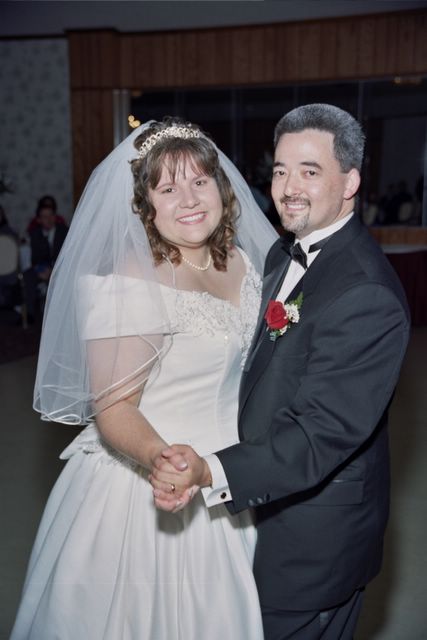
I don't know which is worse, this, or the fact that K-Fed & Britney are spawing a 2nd time... God help us all.
Wednesday, June 21, 2006


Tuesday, June 20, 2006
Luau, Part II
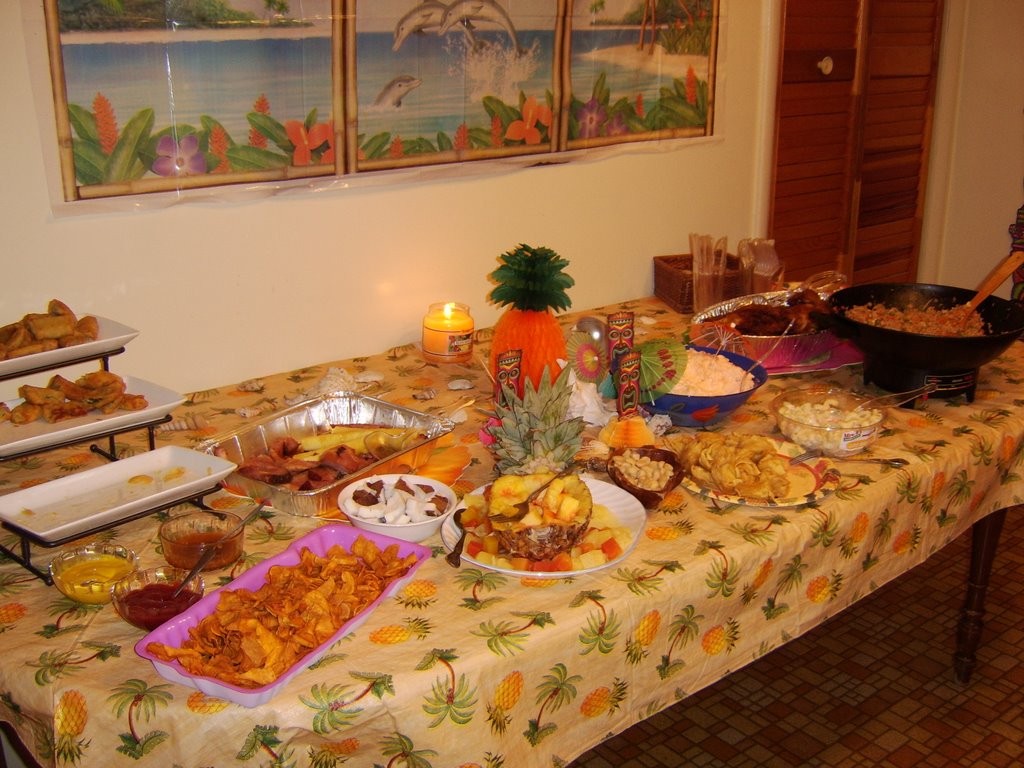 Ok, this is a picture of the tablescape from the luau that we had on Saturday. I had tried repeatedly to post the picture, but for some reason, I was unable to. The wok on the right had the fried rice Chrissy's sister Noelle made. You can't see, but the pinkish tray on the front left corner of the table had a tiki face on it. It is holding sweet potato chips. The 3-tier tray directly behind it was a wedding gift from one of the guests, Sharon. All in all, I think it was a great success. Everyone seemed very surprised and pleased with the lengths to which we went to decorate everything. If I can get the image tool to work again, I'll post a picture of Chrissy and me in our luau gear. :-)
This is So Friggin' Bizarre
Everytime Connie Chung Says Goodbye We Die A Little, Especially This Time - Gawker
This is Farrah-on-Letterman/Cruise-on-Oprah-level weirdness. I'm talking Howard-Dean-scream weird. Actually, it reminds me of Ashcroft singing, "Let the Eagle Soar." Eeee... Wonder if she was boozin' it up before this show. Or maybe she started doing drugs. Who knows?
This is Farrah-on-Letterman/Cruise-on-Oprah-level weirdness. I'm talking Howard-Dean-scream weird. Actually, it reminds me of Ashcroft singing, "Let the Eagle Soar." Eeee... Wonder if she was boozin' it up before this show. Or maybe she started doing drugs. Who knows?
Monday, June 19, 2006
Turning Up 'American Idol'
Turning Up 'American Idol'
This is an amazing article that about a man who was born with a defective gene that made his hearing all but gone by the time he started school. He really has an incredible perspective on life in general. I think that people's attitudes really have a lot to do with how they happy they are in life. Some people are bound and determined to be miserable and no matter what happens to the, by God, they are going to be miserable! In any case, I was very moved by Mr. Swiller's story. I would recommend that anyone read it.
This is an amazing article that about a man who was born with a defective gene that made his hearing all but gone by the time he started school. He really has an incredible perspective on life in general. I think that people's attitudes really have a lot to do with how they happy they are in life. Some people are bound and determined to be miserable and no matter what happens to the, by God, they are going to be miserable! In any case, I was very moved by Mr. Swiller's story. I would recommend that anyone read it.
Sunday, June 18, 2006
A Weekend of Extremes
Well, we went to New Jersey this weekend to visit with Chrissy's family. We had a luau last night with a bunch of our friends, and that went great. We baked a ham, fried some rice and got some chicken, we had crab rangoon appetizers as well as chicken and vegetable spring rolls. We had rum (yum!). Basically anything remotely polynesian, we got. Of course, we fed 12 people and still had leftovers for about 8 more meals. But that's nothing unusual for us. So that was the good...
Then, this morning, we were meeting Chrissy's cousin Denise and Aunt Fran for breakfast at a restaurant she highly recommended. Then we were going to visit her Aunt Kay, who is in a physical rehab center recovering from breaking a pelvis bone in a fall. If she follows orders, she should be able to go gome in a few weeks, but she's pretty stubborn. She's already had one setback because she was trying to do too much herself.
But I digress. We went to a restaurant in Maple Shade, NJ, called Maritsa's. We had forgotten it was Father's Day, and had to wait a little bit for a table. No problem. After a bit, we got seated. The waitress took our order, including our usual "pork roll well done," and the wait began. After about 15-20 minutes, we started seeing people around us finish their meals and leave, and other patrons being seated and ordering. Then, we started seeing the new patrons getting their food! So we snagged the passing waitress and asked if it would be much longer, and were told (with no apology) that "he" was real busy and backed up and it wouldn't be long. Another 10-15 minutes later, Denise got up and asked the manager how much longer it would be, because she had to leave for work soon. She was assured that it would be any minute. Another 10 minutes or so later, we decided that if one more table that was seated after us got served before us, we would leave. No sooner did we decide that, then the table next to us got served. So we get up to leave. As we pass the counter, the owner/manager sees us and says, "Oh, wait, your food is up!" We turned to each other, trying to decide if we should stay, when the owner's son (and the cook of the restaurant) says, "You want it well done or you want it raw? Get the hell out of here!" I said, "Forget it. Let's leave." I guess the owner decided to back his son and said, "You always complain! We don't want you here! Leave and don't come back!" So long story short (too late), if you're ever in Maple Shade, NJ, don't ever got to Maritsa's on Main Street. The service is slow and apathetic and the owners and cooks are rude.
Then, this morning, we were meeting Chrissy's cousin Denise and Aunt Fran for breakfast at a restaurant she highly recommended. Then we were going to visit her Aunt Kay, who is in a physical rehab center recovering from breaking a pelvis bone in a fall. If she follows orders, she should be able to go gome in a few weeks, but she's pretty stubborn. She's already had one setback because she was trying to do too much herself.
But I digress. We went to a restaurant in Maple Shade, NJ, called Maritsa's. We had forgotten it was Father's Day, and had to wait a little bit for a table. No problem. After a bit, we got seated. The waitress took our order, including our usual "pork roll well done," and the wait began. After about 15-20 minutes, we started seeing people around us finish their meals and leave, and other patrons being seated and ordering. Then, we started seeing the new patrons getting their food! So we snagged the passing waitress and asked if it would be much longer, and were told (with no apology) that "he" was real busy and backed up and it wouldn't be long. Another 10-15 minutes later, Denise got up and asked the manager how much longer it would be, because she had to leave for work soon. She was assured that it would be any minute. Another 10 minutes or so later, we decided that if one more table that was seated after us got served before us, we would leave. No sooner did we decide that, then the table next to us got served. So we get up to leave. As we pass the counter, the owner/manager sees us and says, "Oh, wait, your food is up!" We turned to each other, trying to decide if we should stay, when the owner's son (and the cook of the restaurant) says, "You want it well done or you want it raw? Get the hell out of here!" I said, "Forget it. Let's leave." I guess the owner decided to back his son and said, "You always complain! We don't want you here! Leave and don't come back!" So long story short (too late), if you're ever in Maple Shade, NJ, don't ever got to Maritsa's on Main Street. The service is slow and apathetic and the owners and cooks are rude.
Friday, June 16, 2006
The 40-Yard Line!!
Yow... God, I love the internet. Where would you have seen a story like this before Al Gore created the internet?
In other news, Ben Roethlisberger is an idiot. If you haven't heard, he was riding his motorcycle without a helmet and crashed. He claims now that he will be more careful in the future and wear his helmet. More likely, Cower told him that if he doesn't stop riding or at least wear a helmet, he's off the team. That's what I would do if I were his coach...
In other news, Ben Roethlisberger is an idiot. If you haven't heard, he was riding his motorcycle without a helmet and crashed. He claims now that he will be more careful in the future and wear his helmet. More likely, Cower told him that if he doesn't stop riding or at least wear a helmet, he's off the team. That's what I would do if I were his coach...
Wednesday, June 14, 2006
Blogarithm
Again inspired by my sister's blog, I am adding a Blogarithm button. If you wish to be notified any time I make a new post, however infrequently, simply click on the button at the bottom of the column on the right and follow the instructions. Thanks for reading!
Tuesday, June 06, 2006
YouTube - AL Gore as the president
YouTube - AL Gore as the president
I had heard about this before and I finally watched it. It's friggin' hilarious! Now, I just have to find and watch Stephen Colbert at the White House Correspondents Dinner!
I had heard about this before and I finally watched it. It's friggin' hilarious! Now, I just have to find and watch Stephen Colbert at the White House Correspondents Dinner!
Wednesday, May 31, 2006
Ted Koppel's Speech
I can't vouch for its accuracy, but according to The Bay Net News, this is what Koppel said at my neice's graduation. Unfortunately, they leave out his hilarious opening remarks. He started by saying that he knew some people were hoping it would be a short speech and "Why, oh why did I drink that much last night?" "No," he said, "I wrote it, and you're going to listen to it." He also said something to the effect that he's been paid enough money over the years that, if he was wearing a rug, it would look a lot better than his hair looked. In any case, enough of me, on to Mr. Koppel:
"I want to talk to you today about time... and television... and the relevance of one to the other. Let's talk first about TIME. There is, in each of us, just enough ego that we tend to regard time as something which is synonymous with our individual lifetime. We measure time in terms of our own experience. For some among you, the past 20 years represent, quite literally, a lifetime. For your younger brothers and sisters, it's even more than that, it's history. For your parents, your grandparents and me, it's the blink of an eye. One of the most jarring aspects of getting older is the sudden retaliation that time does indeed pass just as quickly as our parents once said it did. Even within some of the younger amongst you here today, there is the gnawing sense that not all of life's treasures lie ahead of you-that there is also something of value in what is past. You should be warned that it becomes increasingly easy, as you get older, to drown in nostalgia. In fact, you can almost measure where you are in life by the degree to which you have begun looking back rather than ahead. Some, among the very old, lose themselves completely in the past, presumably on the grounds that they no longer care, or dare to look ahead. Some, among the very young, lose themselves entirely in the future, perhaps in the expectation that there is always some promise in the unknown. Both are illusions. John Lennon once said, "Life is what happens while you're making plans." Time doesn't pass. We do, hurtling across the face of a continuum. More than 75 years ago my father bought a small bronze, which I took into my home after he died. It's the figure of a lithe young woman, head back, hair streaming out behind her, her whole body balanced on the ball of one foot, frozen in the act of running, endlessly running. The bronze is entitled "Fleeting Time." But time doesn't race by any more than that bronze has moved in the past 75 years. She stands absolutely still, frozen in the illusion of motion; and my entire family, my mother, my father, my wife, her mother and father, our children and I have raced past the motionless figure of Time, believing all the while that she was running and we were standing still.
"Life is what happens while you're making plans."
"The passing of a generation, the span of a lifetime, the difference between youth and middle-age, or the passage from middle-age to what is poetically referred to as the winter of our lives, passes as quickly as a sigh. And as we sweep past the figure of Time, we in the profession of television perfect the art of measuring Time in teaspoons. I'll come back to that image in a few moments.
"Have you ever wondered why it is that the human race is so intolerant of excellence, so unforgiving of originality? We tend to reserve our highest praise and our richest rewards for those whom we can understand. We encourage banality because it threatens none of our preconceptions. We raise conformity to the level of high achievement by offering it as society's best alternative to anarchy; and perhaps it is. But we tend to be truly comfortable with excellence only when its practitioners are dead, or very old, or engaged in some activity which we are free to ignore.
"One of the greatest crimes against society is to threaten the status quo with new ideas. New ideas force us to unravel and re-weave the fabric of our lives. The need for change, after all, implies that there is something lacking, or even wrong, with the way we are. In repressive and totalitarian societies change is either suppressed or, eventually, achieved by violence and imprisonment at the least. In democratic societies like our own, change is the product of gradualism. The ideas of an old Socialist like Norman Thomas, for example, suggested changes far too extreme and far too abrupt to be acceptable when they were first proposed more than 70 years ago. Now, many of them, like social security itself for example, have become such an indispensable part of our society that it would amount to political suicide for anyone to propose dismantling that system. Those then would seem to be the alternatives: abrupt change, imposed by force, quickly, and therefore almost violently, or gradual change that awaits the benediction of a democratic process that is so long, and frequently so tedious that some of the best ideas are stupefied by the endless journey toward consensus.
"And so they come together, these two thoughts: excellence and Time. How to achieve the first, under the assault of the second? How, as a society, we can transcend mediocrity without resorting to revolution? To propose television as an answer to mediocrity is to invite ridicule. Television embodies mediocrity. Its economic framework is designed to appeal to the greatest possible number with the lowest common denominator. Insofar as it even matters who watches a program, it's only a question of meeting Madison Avenue's demand for a particular demographic. Yours, as it turns out. And that is as true of television news and sports as it is of entertainment programming on television. And yet, I do propose television as both the medium for excellence and the means toward telescoping Time.
"We are, as I suggested a few minutes ago, guilty in television of measuring Time in teaspoons. On television news in particular, we tend to find ourselves in a headlong race to be first with the obvious. We are obsessed with immediacy. We gauge the importance of an event by two criteria: who said it or did it, and how recently was it said or done. We thrive on confrontation. And since ours is a society in which elections take place every two years, we have an endless parade of "outs" to challenge the plans and claims of the "ins." What is lost in the constant exchange of political sloganeering is both a sense of context and national purpose. Consider, for example, the national debate over immigration policy. It's all reduced to simplistic concepts: secure borders, the jobs Americans won't do, singing our national anthem in English or Spanish. Absolute success for either side in this debate would be catastrophic to our national interest; but compromise-which must and will be the only path to a solution-does not easily lend itself to powerful slogans of the left or the right. Clever slogans can induce us to elect bad leaders, and initially to support flawed policies. But you can't sustain either on slogans.
"We wonder, as we look back on the past twenty-some odd years of your lifetime, whether we have lost our sense of direction. There's nothing wrong with the system. We simply have to ask ourselves more often, as journalists, as an electorate, WHY something is important. We've become so obsessed with facts that we sometimes lose all touch with the truth. Ultimately, of course, Time provides context. It's usually a far truer glass through which to view events than a television camera. But Time is an expensive prism through which to gain a proper perspective of events. The wisdom we gain after the passage of Time is frequently irrelevant to the particular even that once might have benefitted from that wisdom, unless that wisdom is applied in a fresh way that makes it relevant. Listen to what Walk Whitman had to say about the universality of human experience, and consider how uniquely qualified television could be to spread that message:
"It avails not," Whitman wrote more than 120 years ago,
"It avails not, time nor place - distance avails not,
I am with you, you men and women of a generation, or ever so many generations hence.
Just as you feel when you look on the river and sky, so I felt.
Just as any of you in one of a living crowd, I was one of a crowd.
Just as any of you are refresh'd by the gladness of the river and bright flow, I was refresh'd.
Just as you stand and lean on the rail, yet hurry with the swift current, I stood yet was hurried,
What is it then between us?
What is the count of the scores of hundreds of years between us?
Whatever it is, it avails not - distance avails not, and place avails not."
"So wrote Whitman in 'Crossing Brooklyn Ferry.' There is a universality of man that spans distance and Time. And, for the first time in history, it is a universality that can be seen and heard in almost every home in America. Film and videotape span Time; we can hear and see what happened in the past. Satellite transmissions span distance. We have the technology to hear and see what is happening in the remotest corners of the earth. We need only apply excellence and make it understandable, to revolutionize our era, quickly and without violence.
"What a challenge.
What an opportunity.
You have all the tools.
Now seize the moment!"
"I want to talk to you today about time... and television... and the relevance of one to the other. Let's talk first about TIME. There is, in each of us, just enough ego that we tend to regard time as something which is synonymous with our individual lifetime. We measure time in terms of our own experience. For some among you, the past 20 years represent, quite literally, a lifetime. For your younger brothers and sisters, it's even more than that, it's history. For your parents, your grandparents and me, it's the blink of an eye. One of the most jarring aspects of getting older is the sudden retaliation that time does indeed pass just as quickly as our parents once said it did. Even within some of the younger amongst you here today, there is the gnawing sense that not all of life's treasures lie ahead of you-that there is also something of value in what is past. You should be warned that it becomes increasingly easy, as you get older, to drown in nostalgia. In fact, you can almost measure where you are in life by the degree to which you have begun looking back rather than ahead. Some, among the very old, lose themselves completely in the past, presumably on the grounds that they no longer care, or dare to look ahead. Some, among the very young, lose themselves entirely in the future, perhaps in the expectation that there is always some promise in the unknown. Both are illusions. John Lennon once said, "Life is what happens while you're making plans." Time doesn't pass. We do, hurtling across the face of a continuum. More than 75 years ago my father bought a small bronze, which I took into my home after he died. It's the figure of a lithe young woman, head back, hair streaming out behind her, her whole body balanced on the ball of one foot, frozen in the act of running, endlessly running. The bronze is entitled "Fleeting Time." But time doesn't race by any more than that bronze has moved in the past 75 years. She stands absolutely still, frozen in the illusion of motion; and my entire family, my mother, my father, my wife, her mother and father, our children and I have raced past the motionless figure of Time, believing all the while that she was running and we were standing still.
"Life is what happens while you're making plans."
"The passing of a generation, the span of a lifetime, the difference between youth and middle-age, or the passage from middle-age to what is poetically referred to as the winter of our lives, passes as quickly as a sigh. And as we sweep past the figure of Time, we in the profession of television perfect the art of measuring Time in teaspoons. I'll come back to that image in a few moments.
"Have you ever wondered why it is that the human race is so intolerant of excellence, so unforgiving of originality? We tend to reserve our highest praise and our richest rewards for those whom we can understand. We encourage banality because it threatens none of our preconceptions. We raise conformity to the level of high achievement by offering it as society's best alternative to anarchy; and perhaps it is. But we tend to be truly comfortable with excellence only when its practitioners are dead, or very old, or engaged in some activity which we are free to ignore.
"One of the greatest crimes against society is to threaten the status quo with new ideas. New ideas force us to unravel and re-weave the fabric of our lives. The need for change, after all, implies that there is something lacking, or even wrong, with the way we are. In repressive and totalitarian societies change is either suppressed or, eventually, achieved by violence and imprisonment at the least. In democratic societies like our own, change is the product of gradualism. The ideas of an old Socialist like Norman Thomas, for example, suggested changes far too extreme and far too abrupt to be acceptable when they were first proposed more than 70 years ago. Now, many of them, like social security itself for example, have become such an indispensable part of our society that it would amount to political suicide for anyone to propose dismantling that system. Those then would seem to be the alternatives: abrupt change, imposed by force, quickly, and therefore almost violently, or gradual change that awaits the benediction of a democratic process that is so long, and frequently so tedious that some of the best ideas are stupefied by the endless journey toward consensus.
"And so they come together, these two thoughts: excellence and Time. How to achieve the first, under the assault of the second? How, as a society, we can transcend mediocrity without resorting to revolution? To propose television as an answer to mediocrity is to invite ridicule. Television embodies mediocrity. Its economic framework is designed to appeal to the greatest possible number with the lowest common denominator. Insofar as it even matters who watches a program, it's only a question of meeting Madison Avenue's demand for a particular demographic. Yours, as it turns out. And that is as true of television news and sports as it is of entertainment programming on television. And yet, I do propose television as both the medium for excellence and the means toward telescoping Time.
"We are, as I suggested a few minutes ago, guilty in television of measuring Time in teaspoons. On television news in particular, we tend to find ourselves in a headlong race to be first with the obvious. We are obsessed with immediacy. We gauge the importance of an event by two criteria: who said it or did it, and how recently was it said or done. We thrive on confrontation. And since ours is a society in which elections take place every two years, we have an endless parade of "outs" to challenge the plans and claims of the "ins." What is lost in the constant exchange of political sloganeering is both a sense of context and national purpose. Consider, for example, the national debate over immigration policy. It's all reduced to simplistic concepts: secure borders, the jobs Americans won't do, singing our national anthem in English or Spanish. Absolute success for either side in this debate would be catastrophic to our national interest; but compromise-which must and will be the only path to a solution-does not easily lend itself to powerful slogans of the left or the right. Clever slogans can induce us to elect bad leaders, and initially to support flawed policies. But you can't sustain either on slogans.
"We wonder, as we look back on the past twenty-some odd years of your lifetime, whether we have lost our sense of direction. There's nothing wrong with the system. We simply have to ask ourselves more often, as journalists, as an electorate, WHY something is important. We've become so obsessed with facts that we sometimes lose all touch with the truth. Ultimately, of course, Time provides context. It's usually a far truer glass through which to view events than a television camera. But Time is an expensive prism through which to gain a proper perspective of events. The wisdom we gain after the passage of Time is frequently irrelevant to the particular even that once might have benefitted from that wisdom, unless that wisdom is applied in a fresh way that makes it relevant. Listen to what Walk Whitman had to say about the universality of human experience, and consider how uniquely qualified television could be to spread that message:
"It avails not," Whitman wrote more than 120 years ago,
"It avails not, time nor place - distance avails not,
I am with you, you men and women of a generation, or ever so many generations hence.
Just as you feel when you look on the river and sky, so I felt.
Just as any of you in one of a living crowd, I was one of a crowd.
Just as any of you are refresh'd by the gladness of the river and bright flow, I was refresh'd.
Just as you stand and lean on the rail, yet hurry with the swift current, I stood yet was hurried,
What is it then between us?
What is the count of the scores of hundreds of years between us?
Whatever it is, it avails not - distance avails not, and place avails not."
"So wrote Whitman in 'Crossing Brooklyn Ferry.' There is a universality of man that spans distance and Time. And, for the first time in history, it is a universality that can be seen and heard in almost every home in America. Film and videotape span Time; we can hear and see what happened in the past. Satellite transmissions span distance. We have the technology to hear and see what is happening in the remotest corners of the earth. We need only apply excellence and make it understandable, to revolutionize our era, quickly and without violence.
"What a challenge.
What an opportunity.
You have all the tools.
Now seize the moment!"
Friday, May 26, 2006
Soul Patrol!
Taylor Hicks is the winner of American Idol, Season 5! WOO HOO!! I still can't say that I have complete faith in the voting process, but we're happy Taylor won. If Chris wasn't going to win, Taylor definitely deserved it.
Subscribe to:
Posts (Atom)